It is about this time of the year that the Rev' starts raving about the truck series, and this year is no exception. In spite of the new pit rules in the Camping World Truck Series (CWTS)--as well as the economic situation that is leaving some of the best teams and drivers unsponsored--the trucks continue to offer us some of the best racing on television.
Atlanta is always a good race, no matter which series is racing there, and the trucks lived up to the reputation. As was the case at California, Kyle Busch held the pole position, but, contrary to the California race, he did not dominate from the start.
Kevin Harvick was feeling quite racey from the start, and he quickly took the lead. From then on, the racing for the lead never stopped. In fact, from the lead all the way back to fifteenth, the racing never stopped, and we certainly got our share of the beatin' and bangin' we expect from the Truck Series.
The new NASCAR requirement for the double pit stops receives a B- from Rev' Jim. We do have to admit, that it does add some drama during long green runs, as strategy comes into play. A stop for tires early in the fuel run, for example, may produce an advantage for a team that is looking to improve handling, and to be able to make one stop for fuel only during the caution, when and if it comes. Most teams will wait until the almost inevitable caution, and pit twice during that period.
The problem we see in this is that it takes a factor away from the racing and gives it to pit strategy. Pit strategy is fine for the longer Sprint Cup races, but, during the relatively short Truck races, it just doesn't seem to fit. Pit strategy in the Truck races should only be about who can get four tires and fuel the fastest.
However, when the racing on track is as good as it was at Atlanta, Saturday afternoon, we can forget what the pit road rules put into play.
They mixed it up for the entire 200 miles. Newcomers Ricky Carmichael, JR Fitzpatrick, and Max Papis, along with relatively new drivers like Colin Braun, Brian Scott, and Timothy Peters, race fender to fender with former champions like Hornaday, Todd Bodine, Johnny Benson, and Mike Skinner. Grizzled veterans like Terry Cook and Matt Crafton are out to show the world that their racing days aren't over, and they mix it up throughout the race as well. Still, after every restart--even though other drivers get a chance to lead for a little while--it always seems to come down to Harvick and Busch fighting for the lead.
Late in the race, with eight laps to go, Kyle Busch fell back to ninth place at the restart, having lost second and third gear. It looked like the race to the checkers would be between Harvick and Bodine.
But Kyle Busch wasn't out of the race. Lugging his engine in fourth gear, he slowly built up speed, and was challenging Harvick for second with four laps to go. Not letting off the gas for anything, Busch soon passed Harvick and raced Bodine, passing him with three to go and with Harvick on his rear bumper.
Harvick momentarily took the lead, but Busch got it back almost immediately, keeping his accelerator floored even as he was turned nearly sideways. The battle for first never let up, going into the final turn and all the way to the finish line. For the first time this year, we got the kind of finish we like to see in the truck series.
And Kyle Busch won his second Truck Series race in a row, by less than a half a second. Once again, we have to appreciate the driving ability of this young man from Las Vegas, Nevada. We could be seeing greatness in the making. Most of the fans in the stands at Atlanta Motor Speedway could have been thinking the same thing as they gave Busch a rousing and enthusiastic ovation. We couldn't see any beer cans or seat cushions being thrown. Times have changed.
The truck series season is only now beginning. Daytona didn't really count, because superspeedway racing really doesn't fit well with the trucks, and California, well, enough has been said about that. In two weeks, things will really heat up at Martinsville. Short track racing is what the Truck Series is all about.
Saturday, March 07, 2009
And this is only the beginning


Friday, May 02, 2008
Looking forward to Richmond
There is no mistaking that our favorite races on the NASCAR Sprint Cup circuit take place at the tracks that are 1.36 miles in length or shorter. There are no "cookie cutters" here--every track is unique.
This group includes Darlington, Richmond, Bristol, Loudon, Dover, Martinsville, Phoenix, and Richmond. It is very difficult to pick a favorite out of these, but mine is Richmond. The frontstretch, with its long, 8 degree banked curve, and long turns with 14 degree banking at each end of the straightaways, make for some very interesting racing. Like most short tracks, it usually features plenty of bumpin' and bangin' while at the same time offering multiple grooves and side by side racing. Like most short track racing, the Dan Lowry 400 at Richmond will focus on drivers skills and guts.
Denny Hamlin is on a tear. Out of the last seven races this year, he has posted six top ten finishes, including five top fives and one win. That win was at the other Virginia short track, Martinsville, and there is no doubt that he could make it two for two in his home state.
He won't do it without some competition. There are several other drivers who consider Richmond their favorite track, and have records to prove it. Tony Stewart and Dale Earnhardt, Jr each have three wins at the track, and Kyle Busch has only finished outside of the top five in one out of six races there. Jimmie Johnson swept both Richmond last year, and Kevin Harvick has the top driver rating* at Richmond with a 121.2
*Driver Rating : Formula combining the following categories: Wins, Finishes, Top-15 Finishes, Average Running Position While on Lead Lap, Average Speed Under Green, Fastest Lap, Led Most Laps, Lead-Lap Finish. Maximum: 150 points per race. (Racing One.com)
We can't overlook Mark Martin here, either, because he has 23 top ten finishes at Richmond, the most of any current driver. Ryan Newman, however has the best finishing average of all drivers who have raced in every Cup race at Richmond since 2002.
So the competition is going to be tough, the action fast paced, and the racing hard. There should be plenty of green flag racing, since there is some passing room there, but there will also be times when the traffic is thick, and mistakes will be made.
I'm guessing a JGR sweep of the top three places this week. All three drivers have the guts and aggressiveness it takes to win at a track like Richmond, and they arguably have the best cars in the field.
But then, the beauty of short track racing is that anybody can win.
Wednesday, January 30, 2008
More pre season fun!
I had a great weekend. It was good watching cars go fast on television again. It didn't quite bring the satisfaction five-hundred miles of beatin' and bangin' brings us, but it was racing and it did bring some thrills, to break what seems like the longest 11 week off-season ever. We should be happy we aren't football fans, because eleven weeks is actually the shortest off season of any professional sport.
The Rolex Grand American Series 24 Hours at Daytona isn't, in reality, a NASCAR event, but most race fans are familiar with the names of some of the drivers, and the sights and sounds are a nice break in the tedium of off season.
There were some records broken. Team Ganassi chalked up an unprecedented third straight victory in the event, with the #01 drivers team of Memo Rojas, Dario Franchitti, Juan Paul Montoya, and Scott Pruett, each an excellent and experienced driver in his own field. Due partly to the weather, partly to mechanical failure, and partly to the advanced level of competition, the attrition rate was high, and the #01 car crossed the finish line two laps ahead of the closest competitor, the #99 team of Jimmie Johnson, Alex Gurney (the son of racing legend Dan Gurney), Jimmy Vasser, and Jon Fogarty. Fogarty and Gurney were the Rolex Series Champions at the end of last year's season.
There were 23 caution flags, and 16 lead changes, both new records.
Daytona testing didn't tell us a whole lot about the new (CoT) Formula N cars. Just that the engines were working good, and maybe working with wedge, trackbar, and alignment adjustments to find that comfort spot for the drivers. Everything else is mandated by NASCAR to be the same for every team at Daytona. But now, at Vegas, there are a few more things the teams can work with. There is much more the Crew Chiefs can do as far as aerodynamics adjustments go than they could do at Daytona. As explained very well by Larry McReynolds on Speed TV, the rear wing and the struts that support it can be adjusted in several ways, in addition to changing the shape of the struts. Plus the front splitter is adjustable, to change the downforce on the front end, as well as the suspension adjustments that couldn't be done at Daytona.
So, once everyone found out how the track and the tires worked, they went to work on set ups and experiments.
Some of the experiments obviously failed, as both Tony Stewart and Jeff Burton had equipment failures in the front suspension and crashed, leaving their teams with only one car for California testing Thursday and Friday. David Regan's crew chief accepted responsibility for a loose condition he set up in his driver's car.
This brings up a point about the new Formula N car that may not have been forseen in the developmental stages. The car was supposed to make racing affordable by all the teams, but it seems that nobody can afford to wreck one.
"The car that Jeff [Burton] crashed is junk -- it'll be easier to replace it than it would be to put it back together," (RCR crew chief Gil) Martin said. "Anyone who thinks these cars will be able to take a beating better than the [standard cars] is kidding themselves.(from NASCAR.com)
"With the [chassis] recertification process and the tolerances we have to meet, it's easier and cheaper to just build a new one than to go to the effort of repairing one."
It also seems that the car that was supposed to allow the teams to use the same car for everything from road courses to the superspeedways does not actually exist. In a NASCAR.com article from California Speedway, Kevin Harvick answered a question pertaining to the multi usefulness of the new Formula N car.
When he was asked during Thursday's lunch break at California Speedway if the chassis that Sprint Cup teams must use this season will enable organizations to use the same cars at different tracks, Kevin Harvick said yes, but only to a point.
"With these cars, you could use the same thing from a track like Bristol [short track] to here at California [intermediate, downforce track]," Harvick said. "We're using the same cars we had at Las Vegas, with minor setup changes.
"As far as the other tracks, we'll always have road-course cars and we'll always have speedway cars [for Daytona and Talladega]. But the interesting thing is, one of the cars we have here is the center section from one of last year's road-course cars, with new front and rear clips."
Dave Rodman, NASCAR.COM
But we should remember that a similar situation came in play in the Rolex Grand Am Series in 2003 with the introduction of the Daytona Prototype (DP) car. As pointed out by Charlie Turner, of Bench Racing With Steve and Charlie--in an excellent article, by the way--the DP was suppose to be a safer and less expensive alternative for the teams than the purpose built sports cars that were being used in the series at the time. There were complaints and widespread non-acceptence, but after four years, the DP has made its own history. Perhaps this tells us we need to give the Formula N car a little more time.
So the experiments at Las Vegas testing resulted in the conclusion of "we know we better not do that again"
Once this week of testing is over, there is nothing left to do but begin the exciting, or, at least, much anticipated 2008 season. The Bud Shootout is a little more than a week away, with nothing in between now and then. Unless you want to watch that thing called the Daytona 500 of Professional Football, which I, personally can't get excited about. If they could only make the players about 3000 lbs heavier and 160 mph faster, maybe they could get me to watch.
Well I have rambled on enough now. This was supposed to have been posted by Tuesday at the latest, but it wasn't so I kept adding to it until I got this mess. Thank you all for bearing with me.
Saturday, November 18, 2006
Fear, Intrepidation, and Anticipation
Apply this quote to the NASCAR season finale at Homestead:
'No turning back!?' Why did you have to go and say that? That's as bad as saying, 'nothing else can go wrong now,' or 'this will be Fluffy's best Christmas ever.'--Doctor Who
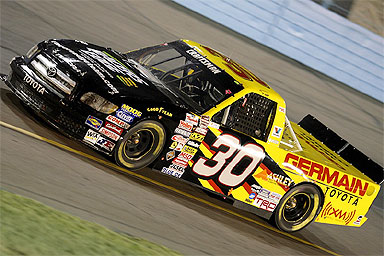
Todd Bodine won the Craftsman Truck Series (CTS) Championship Friday night, and all he had to do was finish the race. Our favorite, Johnny Benson, still had a chance to beat Bodine in points, until, while racing for second place, a truck spun into the infield, and then slid back up the track, right in front of him. There was no avoiding it, and Benson's hopes for the CTS Trophy disappeared long before the race was over. He was able to finish the race, but he finished in twenty-sixth place. What he needed was to finish in the top three positions, and have Todd Bodine finish twenty-eighth or worse. Bodine played it safe, running steadily in the twenty-first to twenty-sixth positions, not taking any chances. He finished twenty-second, which, considering Benson's troubles, was more than good enough to win the Championship.
Mark Martin won the race. His limited schedule in the truck series yielded a very high percentage of wins. In each race he entered in the CTS this season, he immediately became the one to beat. In eight of the CTS races this season, he either won or came in second.
Martin wa originally slated to race in CTS full time, next season, but, not wanting to be left out of Cup racing next year, he decided to give up his Ford ride with Roush Racing, and went for a twenty-two race Cup schedule in a Chevy. So, Friday's victory capped Martin's final career truck race in a Roush Ford. Bottom line--Martin, who has not won a NASCAR championship on any level, gave up a nearly certain CTS championship next year for a chance to continue racing in Cup.
Speaking of Cup, and remembering the quote at the start of this post, there is no sure thing about the outcome of the Nextel Cup Championship, or of Sunday's race. No doubt, Jimmie Johnson will be content to run safely in twelfth place for most of the race, which is all he needs to do to win the Championship, but that is easier said than done. The competition is heavy, with four other drivers who have a chance to win the Championship, several others who will race their hearts out to make sure they will have guaranteed in February's Daytona 500, and many others who will be giving it all they've got just to win a race. Johnson, or any of the top five contenders, could get caught up in something involving all these other drivers and see his Championship hopes go to the hauler prematurely.
Dale Earnhardt, Jr., 115 points out of the lead, absolutely has to win the race in order to win the Chase. Even winning wouldn't be enough--Johnson would have to finish thirty-nineth place or worse, and Matt Kenseth would have to have terrible luck. We already know that Earnhardt can't count on anything like that, but, still the Earnhardt fans will be watching just in case something does happen.
What will throw off every scenario for the Championship will be the domination of the Everham teams. Kasey Kahne has the season's best record this season on the intermediate tracks among all the drivers, but team mates Elliot Saddler and Scott Riggs are also very good drivers, and all three Everham drivers qualified in the top four positions on the starting grid--a definite advantage with a good car, and one that may keep any of the Championship contenders from gaining the all-important bonus points for leading a lap.
Brian Vickers may have learned his lesson at Talledega--where he won his first race a few weeks ago, and became arguably the most hated driver in the Cup series. But there are still plenty of wild cards, including Robby Gordon, JJ Yeley, and David Stremme, among many others. Robby Gordon is on the high of winning the Baja 1000 this week, and with a reputation of not giving a darn about other drivers on the track, he will happily ruin someone's Championship hopes to continue his winning streak. Yeley and Stremme, are not bad drivers, just inexperienced and on a steep learning curve. They have both made stupid mistakes this season, which have taken out other drivers, as well as themselves, and the contenders probably fear that the learning period isn't over. In NASCAR, one can't always avoid the mistakes of others.
So, the only predictions I can safely make this weekend is that the Championship will not be determined until the last lap, and that it will be a very exciting and fulfilling race at season's end.
Friday, November 17, 2006
The Big Finale
Well, here we are, at the final race. There is always something melancholy about the end of the season, but the good news is that NASCAR has the shortest off season of all professional sports--twelve weeks from Sunday's race at Homestead until the Daytona 500 in February. And there is more good news--if only in that the season has been probably the best and most exciting since 1998. It has been very satisfying for those of us who can't seem to get enough excitement. And there is the fact that, going into the last race, the Championship has not been decided yet.
Of course, Jimmie Johnson has the best chance to take the Cup, being sixty-three points ahead of second place. This means, he clinches the championship if he finishes seventeenth or better. If he leads a lap during the race, getting bonus points, he only has to finish twelfth or better, regardless of where Matt Kenseth and the other three contenders finish.
Kevin Harvick and Denny Hamlin are tied for third place, ninety points out of the lead. There will likely be times during the race that one or both of them will move up closer to the points lead. Say, for instance, that on lap 112, Kenseth is leading the race, Havick and Hamlin are running in the top ten, and Johnson is way back in twenty-fifth or twenty-sixth place. This situation would put these two guys within thirty points in the lead. This theoretical example is to illustrate exactly how close the championship race is between the top four drivers. As it happens, there are many different sets of circumstances which could put Hamlin or Harvick in the points lead by the end of the race.
Momentum is on Johnson's side, however. The #48 team has been performing exceptionally well since the last race at Talledega, and no amount of bad luck during the race seems to be a handicap for the team by the end. Still, with the competition being what it is, the driver among the top five who has the least bad luck will be the 2006 champion.
None of the contenders can afford to have something like this happen.